Christmas Decor Ideas for Every Room (2026 Update)
Pick one focal point, layer three light sources, repeat two colors. Do those three things and the room reads as decorated - whether you spent $40 or $400.
Key takeaways
- Pick one focal point per room - tree, mantel or window - and let everything else support it
- Flat rooms are a lighting problem, not a decorating problem: add three light sources at three heights
- For an 8-foot ceiling, a 6.5-7 foot tree fits; use about 100 mini lights per foot of tree height
- Small spaces: decorate vertically and at eye level, and stop at three elements
- Cheapest high-impact move: swap pillow covers and add one warm lamp under $30 total
Decorating for Christmas does not have to mean buying a truckload of new bins. The rooms that actually feel festive usually do three things well: they pick one focal point, they layer warm lighting, and they repeat the same two or three colors from room to room. Everything else is optional.
This guide walks through each room, what to prioritize, and the pieces that do the most work per dollar - including options for small apartments, tight budgets, and renters who cannot put a single nail in the wall.
Living room: start with one focal point
Most people decorate by spreading items evenly around a room, which is exactly how you end up with a space that looks busy but not festive. Pick one focal point and let everything else support it.
In most American living rooms that focal point is one of three things: the tree, the fireplace mantel, or the main window.
If it is the tree: size it to your ceiling, not your floor space. For an 8-foot ceiling, a 6.5-7 foot tree leaves room for a topper without crowding. For lights, the rule of thumb is 100 mini lights per foot of tree height - a 7-foot tree wants roughly 700 lights, which usually means two strands. Wrap lights vertically (top to bottom, section by section) rather than spiraling; it takes the same time and looks noticeably fuller.
If it is the mantel: build outward from the center. One anchor piece (a mirror, a large framed print, or a garland swag), then two shorter objects flanking it, then something low in front. Odd numbers and varying heights are what make a mantel look styled instead of lined up.
If it is the window: a single garland across the top plus a hanging accent does more than three competing decorations.
Whichever you pick, repeat your color palette at least once more in the room - a throw pillow, a candle, a ribbon on a basket. Repetition is what reads as decorated rather than stuff added.
Layer your lighting: the fastest fix
If your decorated room still feels flat, the problem is almost never the decorations - it is that you have one overhead light doing all the work.
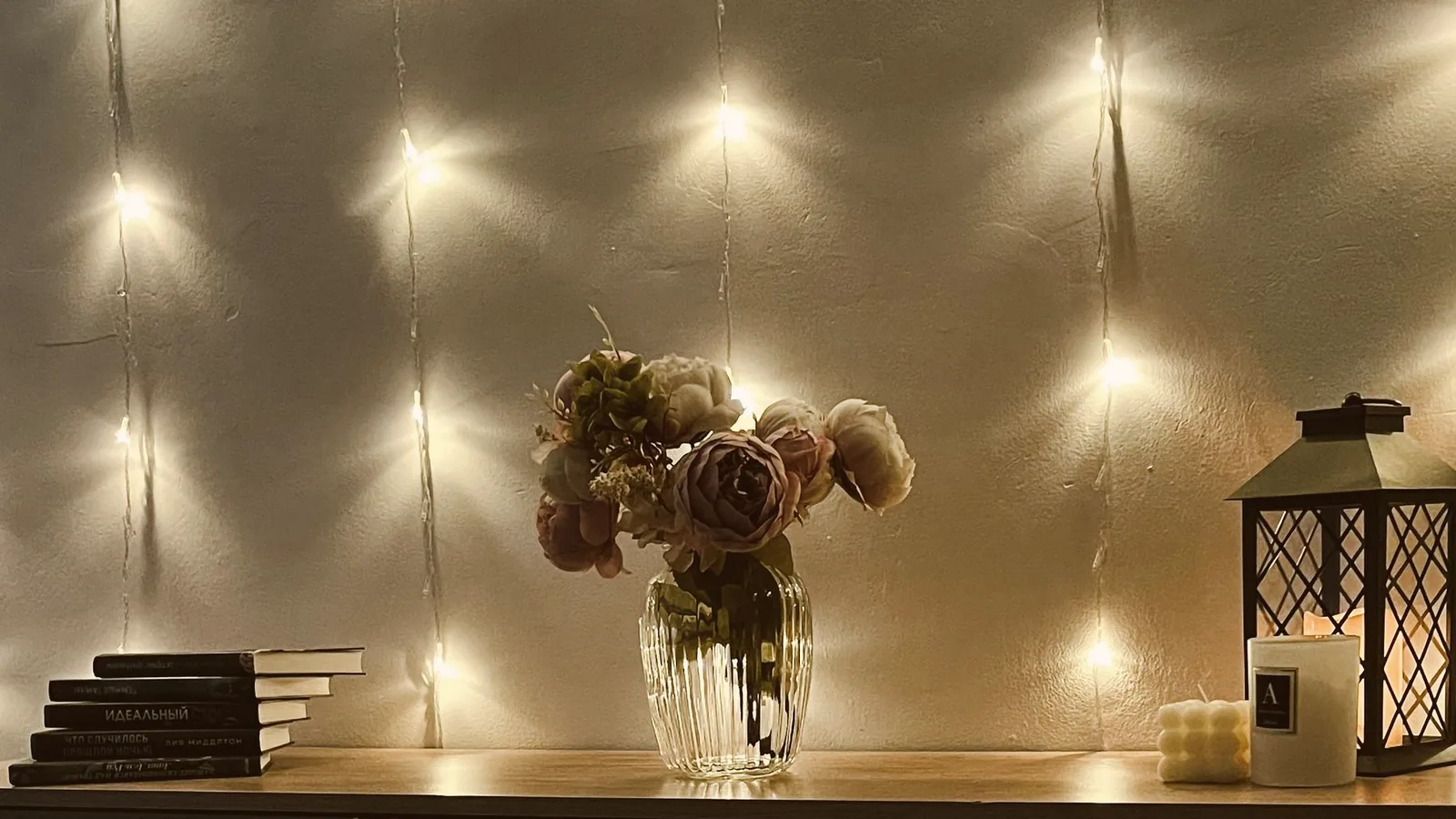
Rooms that feel cozy at night have three light sources at three different heights:
- Ambient - a table lamp or floor lamp at seated eye level (roughly 40-42 inches from the floor for a lamp beside a sofa)
- Accent - string lights, a candle, or a light-up decoration
- Background - your tree lights or a window candle
This is where decorative lamps pay for themselves. A lamp with a cut-out or patterned shade throws light across the walls instead of straight down, which turns a plain corner into something that looks intentional - and it works year-round, not just for three weeks in December. Shop decorative lamps with patterned shades
Two practical notes: use warm white (2700K) bulbs, not daylight - cool white kills the mood instantly. And put your accent lights on a cheap mechanical timer (about $8) so they come on at 5pm without you remembering.
The pieces worth buying (SWAIFDEE)
All three are punched-metal shades from SWAIFDEE - the brand this guide's lighting section is built around. They throw a pattern instead of a flat wash, so a $35-84 shade does the decorative work a $200 fixture would, and keeps working long after the tree comes down. Photos below are placeholders until real product shots are added.
 Best for cozy walls
SWAIFDEE Etched Forest Tree-Pattern Shade
Punched metal forest-and-tree cut-outs throw a soft treeline of shadow onto the wall behind the lamp - the fastest way to make a corner read as Christmas without a single nail. Spider-fitter, drops onto a standard table or floor lamp.
 Best for hanging light
SWAIFDEE Sky-Stars Pendant Shade
A cylinder/pendant shade etched with a starry-sky pattern; warm light spills star-points across the ceiling. Use it as a plug-in pendant over a reading nook or entryway, or swap onto an existing floor-lamp base.
 Best statement piece
SWAIFDEE 3-Tier Drum Shade (Antique Bronze Gold)
The largest, most finished shade in the range: a three-tier drum in antique bronze with a gold interior. Reads as a designed light fixture, not a holiday add-on, so it earns its place year-round in a living room or dining area.
Small spaces and apartments
Small-space Christmas decorating is not about using fewer decorations - it is about decorating vertically and at eye level.
Go up, not out. In a studio or one-bedroom, floor space is the scarce resource and wall space is free. Doorways, the top of a bookshelf, the area above kitchen cabinets, and the inside of a window frame are all fair game.
The pencil tree is the single best small-space buy. A 4.5-6 foot slim or pencil tree takes up about a third of the floor area of a full tree and fits in a corner most people write off. Put it on a small end table or a storage ottoman and it reads as taller without taking more room.
Renters: use tension rods and adhesive hooks. A spring tension rod inside a window frame holds a garland with zero hardware. Command hooks rated for your wall type handle lightweight wreaths - hang them with the hook facing down and the wreath resting on it, rather than trying to hook the wreath frame itself.
One tree, one scent, one light source. Three elements are enough for a 400-square-foot space. Adding a fourth usually makes it feel cluttered rather than festive.
Christmas table decor ideas
A table centerpiece has one job: it has to be low enough to see over. Anything above roughly 14 inches blocks conversation and gets moved anyway.
The three-piece formula: something tall and narrow (taper candles in holders), something low and wide (a tray or runner), and something organic (greenery, pinecones, citrus). Arrange them on a tray and the whole thing moves to the counter in one trip when you need the table.
Budget version: a roll of brown Kraft paper as a runner ($4), a grocery-store bunch of eucalyptus split into three small clusters, and whatever candles you already own. It looks deliberate and costs under $15.
If you host more than once a season, buy neutral (a plain linen runner, clear glass holders) and change only the greenery. Neutral bases get reused; themed bases get stored forever.
Porch and entryway
You get about ten seconds of first impression, and it is after dark half the time.
Three things in order of impact:
- A wreath scaled to the door - about two-thirds the door's width. Most people buy too small.
- A light source that is not your porch light - a battery-operated lantern or a lit garland on the railing.
- A door mat that is not the one you use in July.
If you only do one thing, do the wreath. It is the highest-impact, lowest-effort item on the list, and a decent one lasts five-plus years in a garage.
Christmas decor under $50
The cheapest way to make a room feel decorated is to change the textiles, not add objects.
- Swap pillow covers, not pillows. Covers run $8-12; full pillows run $25+. Same visual result.
- One good ribbon. A 10-yard spool of wired ribbon ($6-9) can do a tree, a wreath, and two cabinet doors.
- Greenery from the grocery store, not the craft store. A $5 bunch of eucalyptus or cedar goes further than a $25 pre-made arrangement.
- Rearrange before you buy. Move your existing candles, trays and books into new groupings first. Most people find they already own 70% of what the room needs.
What to do with it all in January
The part nobody plans for: taking it down.
Label by room, not by category (living room mantel beats ornaments) - it makes next year's setup roughly twice as fast. Use clear bins for anything you want to see before unpacking, and save the original boxes only for fragile items.
If you are short on storage, wrap glass ornaments in tissue and store them in a divided dish rack box - cheaper than ornament organizers and easier to carry.
Common questions
When should I put up Christmas decorations?
Most American households decorate the weekend after Thanksgiving, and there is no rule against earlier. If you are decorating for photos, early-to-mid November gives you better natural light and no competition for your own weekend.
How do I decorate a small apartment for Christmas without it feeling cluttered?
Decorate vertically, keep to three elements (one tree or greenery, one light source, one scent), and repeat the same two colors throughout instead of adding more variety.
What is the cheapest way to make a room feel festive?
Change textiles - pillow covers, a throw, a table runner - and add one warm light source at seated eye level. Under $30 total, and the highest impact per dollar of anything on this list.
Are warm white or cool white Christmas lights better?
Warm white (around 2700K) for anything indoors. Cool white reads as office lighting and flattens a room. Save cool white for outdoor outlines where you want contrast against snow or dark siding.
How many lights do I need for a Christmas tree?
About 100 mini lights per foot of tree height. A 6-foot tree needs roughly 600; a 7.5-foot tree needs roughly 750.